The demo took one evening.
You’ve seen it - maybe you’ve built it. A colleague opens a laptop and shows an AI workflow that summarizes congress abstracts, drafts a medical information response, or turns a folder of event PDFs into a structured dashboard. Built after dinner, mostly by describing what it should do. The room is impressed. Someone says “we need this.”
Twelve months later, ask what happened to it. In most organizations, the honest answer is: nothing. The demo never became a process. And here’s the uncomfortable part - that’s not a failure of the technology. It’s a failure of our expectations.
The Oldest Mistake in Tech Forecasting
There’s a pattern futurists call Amara’s Law: we overestimate what a technology delivers in the short term and underestimate what it delivers in the long term.
AI is the most extreme case of this pattern I’ve seen in my career. Because the short-term part has never looked more convincing. A working prototype in an evening feels like proof that the finished process is weeks away. It isn’t. The prototype is the first 10% that looks like 90%.
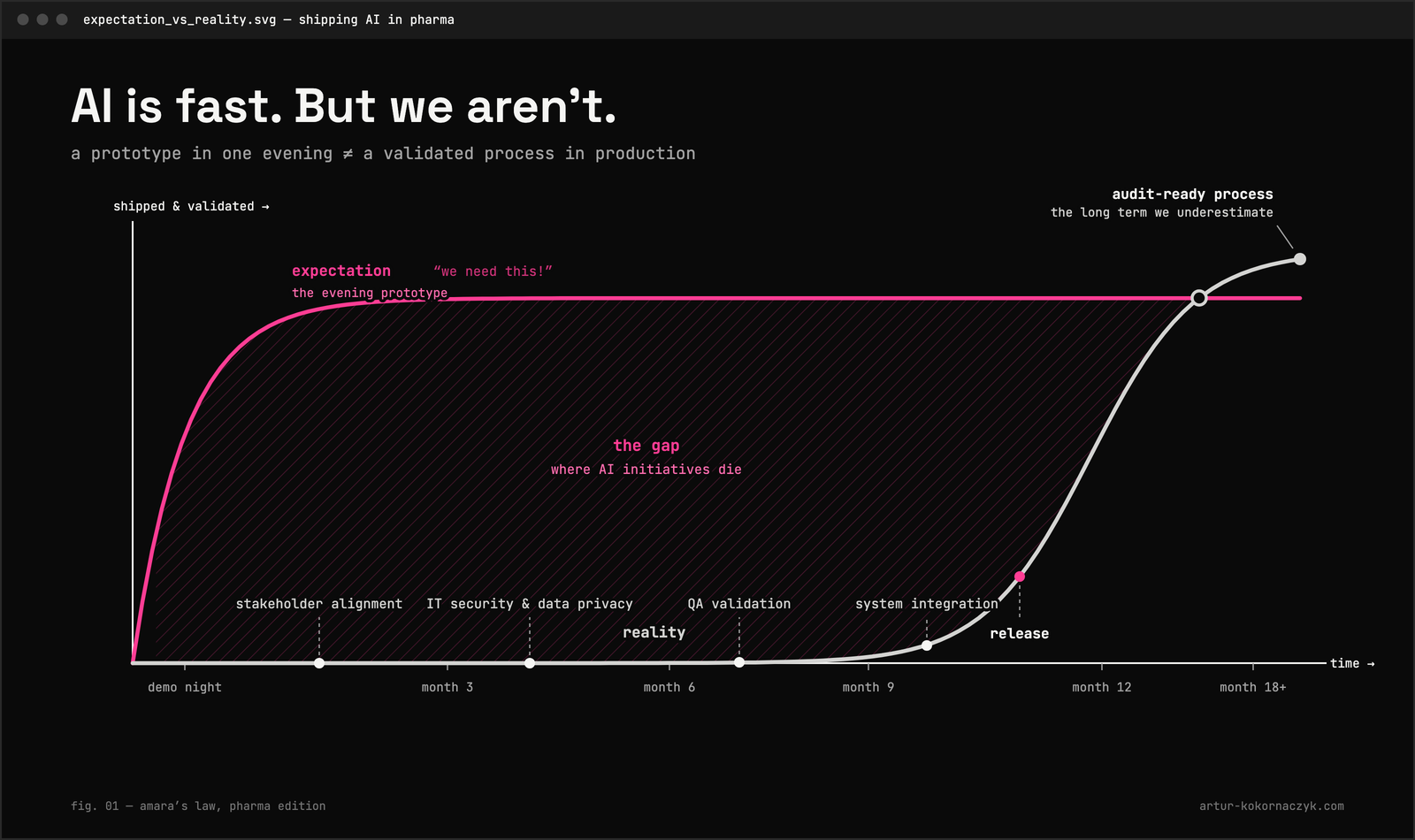
Plot it as two curves: expectation rises steeply the moment people see the demo. Reality climbs slowly, flatly, for months - approvals, validation, integration - and then, much later, crosses the expectation line and keeps climbing past it. The gap between those two curves is where AI initiatives die. Budgets get approved at the peak of the expectation curve and cancelled in the valley of the reality curve - usually right before the slow climb would have paid off.
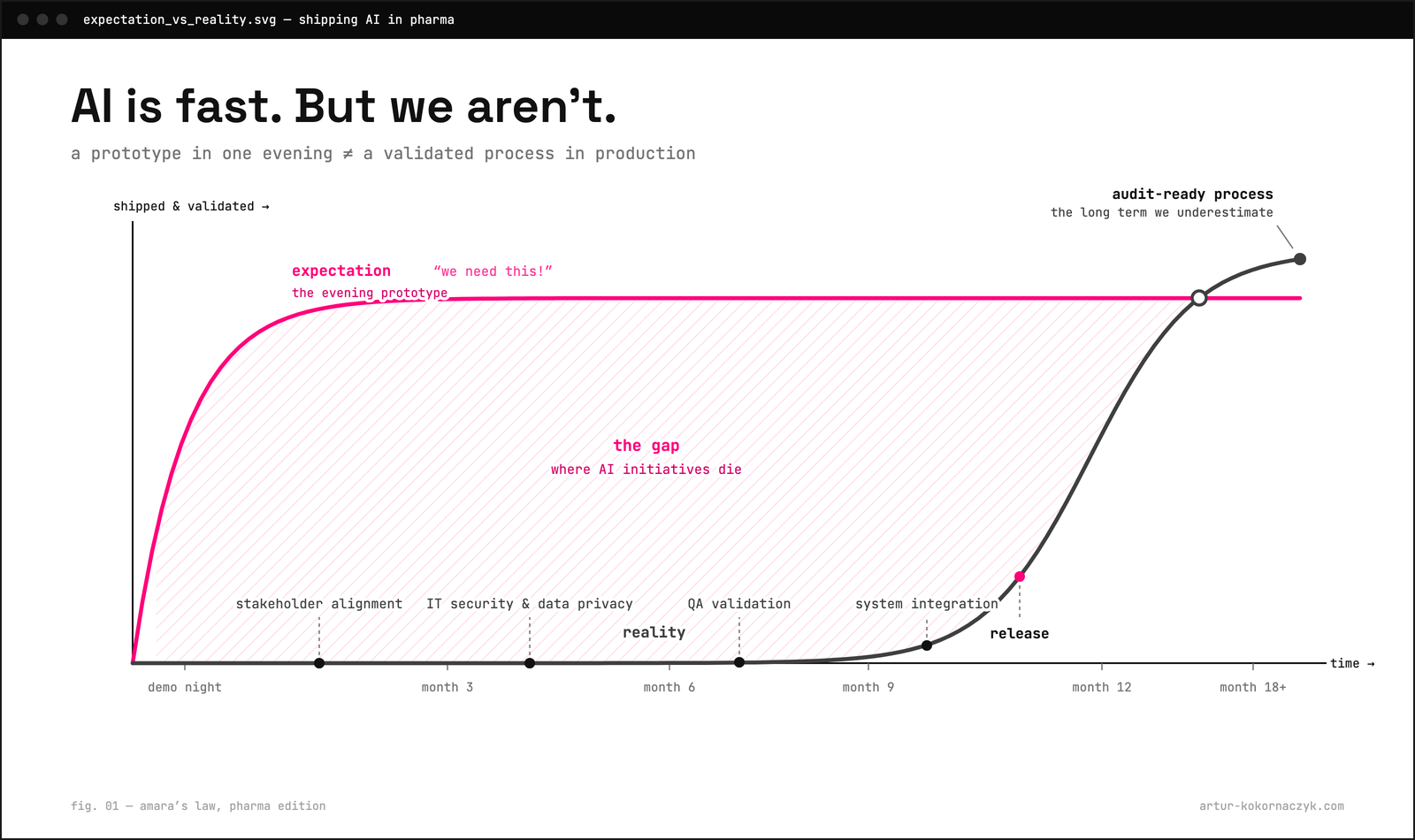
An MIT study made headlines claiming that the vast majority of enterprise GenAI pilots never deliver measurable returns. I don’t read that as “AI doesn’t work.” I read it as: most organizations mistake the demo for the product - and quit in the gap.
AI Accelerates the Easy Part
Here’s the mechanism behind the gap, and it’s worth being precise about it.
Every process that ships in a regulated company is a chain of steps: building the tool, aligning stakeholders, satisfying IT security, validating the system, training users, integrating with existing platforms, passing quality review. AI has made exactly one of those steps dramatically faster: building the tool.
The others move at the speed they always did. The speed of committees, of validation protocols, of change management, of people.
AI accelerates the easiest step of the chain - and leaves the bottleneck untouched.
This is the oldest lesson in operations management, applied to AI: speeding up a non-bottleneck step doesn’t speed up the system. Your prototype now exists 50 times faster than it did in 2021. Your process still ships at the speed of your slowest approval loop. The gap between those two speeds is precisely the gap between expectation and reality.
If anything, faster prototypes make the frustration worse - because the waiting now feels inexplicable. “The tool is done, why isn’t it live?” The tool was never the timeline.
What the Slow Path Actually Looks Like in Pharma
Let me make this concrete with the numbers nobody puts on slides.
A vibecoded afternoon project and an audit-ready process are not two versions of the same thing. They’re different objects. In my previous articles, I described what production-grade AI in pharma requires: a harness with validation gates and audit logs, small specialized models instead of one opaque frontier model, fixed plans, human-in-the-loop touchpoints, state machines for recovery.
None of that exists in the demo. All of it has to be built, reviewed, and validated - inside an organization where every step touches quality, IT security, data privacy, and sometimes regulatory. Add the alignment loops: medical, compliance, IT, works council, global functions. In a large pharma company, taking one workflow from impressive demo to running, auditable process can easily take a year or more.
That number shocks people who have only seen the demo. It shouldn’t. It’s roughly what pharma has always needed to validate and integrate any system that touches regulated work. AI didn’t change that clock. It only changed the prototype clock - and the contrast between the two is what creates the illusion that something is going wrong.
Slow Is a Feature, Not a Bug
Here’s the reframe I want to offer: the slow path isn’t the price you pay despite the value. The slow path is where the value comes from.
The afternoon prototype is fragile. It works on the happy path, on your laptop, with your data, while you’re watching. The year-long build produces something categorically different:
- Robust. It survives edge cases, bad inputs, and the colleague who uses it differently than you intended.
- Integrated. It lives inside the systems people already use - not in a parallel tool that dies when its champion changes roles.
- Auditable. It can show an inspector exactly what it did and why - which is the difference between a tool that’s tolerated and a process that’s trusted.
- Owned. It has gone through enough hands that it belongs to the organization, not to one enthusiast.
A demo that never shipped changed nothing. A boring, validated workflow that runs every day changes everything. In Medical Affairs, this is exactly the line between AI as a conference talking point and AI as actual work relief.
Managing the Two Clocks
The practical skill is learning to run both clocks at once - without confusing them:
- Use the fast clock for discovery, not delivery. Prototype aggressively. An evening prototype is the cheapest requirements document ever invented - it shows stakeholders what’s possible and surfaces real needs. Just never call it a product.
- Set expectations at demo time. The moment you show a prototype, say the second sentence out loud: “This took an evening. The production version takes a year. Here’s why.” You’re managing the expectation curve at its peak - before the gap opens.
- Pick one workflow and go the full distance. One process taken all the way to validated production teaches your organization more than ten pilots. And it creates the template every following workflow reuses - that’s why the second one ships faster.
- Measure progress on the slow curve. Gates passed, validations completed, integrations live. If you measure demos, you’ll optimize for demos.
The Bigger Picture
The second half of Amara’s Law is the part almost everyone forgets while standing in the gap: we underestimate the long term.
The year you spend building the first harnessed, validated workflow doesn’t just produce one process. It produces the governance pattern, the validation template, the IT relationships, and the organizational confidence for every workflow after it. The first one takes a year. The fifth one won’t. That’s the long-term curve quietly compounding while everyone else is still demoing.
The organizations that win with AI in pharma won’t be the ones with the most impressive prototypes. They’ll be the ones that kept building through the unglamorous middle - the months where nothing demos well and everything matters.
AI is fast. Organizations are slow. The winners are the ones who plan for both.
This article builds on my series on AI-driven SOPs in pharma: SOPs for AI · The AI Harness · Nutcrackers, Not Sledgehammers
This article was co-authored with Anthropic’s Claude Fable 5 model. The ideas, domain expertise, and editorial direction are mine - the AI helped structure, draft, and refine the text.